Middle School Advanced Academic Programs
The middle school Advanced Academic Programs (AAP) promote student engagement through enrichment, rigorous coursework, and opportunities to solve real-world problems and to conduct original research.
View additional information on: Curriculum Overview | Curriculum Extensions | Research Class | AAP Recommendation Process | Accelerated Mathematics Program | Enrichment Opportunities
Advanced Academic Programs Curriculum Overview
Students may enroll in one or more advanced classes designed to provide accelerated and enriched learning experiences based upon their readiness and interests. These classes replace the general education course in each subject area and are taught daily by designated content-area teachers.
All Howard County middle schools offer advanced classes in English, Mathematics, Science, and Social Studies, with differentiated curriculum designed to meet the needs of advanced learners.
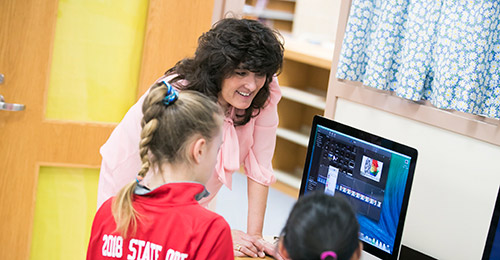
Staff Focus, Tracy Spillman, Advanced Academic Programs Resource Teacher, Lime Kiln Middle School
Tracy Spillman uses her energy and creativity to connect student’s passions to engaging and effective learning experiences. Read more about how she approaches AAP education →
Curriculum By Subject
- English
- Mathematics – Also available: High School Mathemetics Courses and Pathways
- Science
- Social Studies
Advanced curriculum objectives in Advanced English, Science and Social Studies are embedded within the curriculum for that grade level.
Curriculum Extensions
Curriculum Extensions extend the curriculum of the advanced content area classes to provide additional rigor and challenge and to engage students in advanced-level thinking, questioning, and research. These offerings may be taught in collaboration with advanced content area class teachers or by the AAP Resource Teacher alone. Curriculum Extension Units vary by school, with offerings such as Writers Guild and History Day.
Program Overviews
Writers Guild
History Day
Advanced Research Class
Advanced Research is designed for sixth grade students who are recommended by staff for enrollment in Advanced English as well as either Math 7 or PreAlgebra AAP. Participating students receive instruction in advanced-level skills that they apply in their advanced classes. The research class provides a curricular framework for students to become producers of new knowledge as they apply research skills modeled in the curriculum to an original investigation in a self-selected area of study.
Students will learn how to conduct both primary and secondary research in an effort to address a particular topic and research question. As part of the secondary research process, students will learn how to select and define a topic, locate source material, record notes, and assemble a conclusion paper. While working through the primary research process, students will learn how to state a research question, state a hypothesis, determine the appropriate research design, collect data, analyze data, write a conclusion, and present their findings.
Recommendation Process
Students are recommended for advanced content area classes based upon multiple criteria. Students whose scores fall within the designated ranges on at least three of four standardized measures will be recommended for placement in advanced classes:
- 90th** percentile or higher on the Cognitive Abilities Test (CogAT)
- 90th percentile or higher on the Fall Measures of Academic Progress (MAP)
- 90th percentile or higher on the Winter Measures of Academic Progress (MAP)
- Level 4 on MCAP
The following scores are applied to each of the AAP classes:
- Advanced Math
- Advanced English
- CogAT Verbal, MAP-Reading, MCAP-Reading scores
- Advanced Social Studies
- CogAT Verbal-Nonverbal Composite, MAP-Reading, MCAP-Reading scores
- Advanced Science
- CogAT Verbal-Quantitative-Nonverbal Composite, MAP-Reading and MAP-Math, MCAP-Reading and MCAP-Math scores
-
CogAT Quantitative-Nonverbal Composite, MAP-Math, and MCAP-Math scores
**All CogAT Percentiles and Composite scores are Grade Percentile Rank (GPR) and reflect scores from the universal screening in 3rd grade or upon enrollment in HCPSS.
To learn more about the CogAT assessment’s purpose and format, please refer to the What Is CogAT? resource provided by the publisher, Riverside Insights.
In addition to those students whose scores fall within the designated ranges, students also may be recommended to participate in advanced content classes by the school’s AAP Placement Committee. This committee reviews multiple data points related to a student’s performance, including additional assessment scores, student work samples, and report card grades. The committee may recommend enrollment in advanced classes at the end of elementary school or in subsequent middle school years.
If a family disagrees with the recommendation of the AAP Committee, the family has the option to submit the Course Request in HCPSS Connect, which would enroll the student in the requested class. Please contact your current school’s AAP Resource teacher with any questions.
Accelerated Mathematics Program
The Mathematics Program allows students to progress through the sequence of mathematics courses at an accelerated rate. The program is designed for students who show outstanding ability and a high level of performance in mathematics.
The program consists of two course sequences.
First Sequence
In the first sequence, students will enroll in the advanced Algebra I course at their respective middle schools in 6th grade and the advanced Geometry course in 7th grade. In 8th grade, they will enroll in Algebra II and attend a single two-hour class session each week after school or in the evening at a designated HCPSS school and use their in-school math period to complete the required weekly assignments.
Second Sequence
In the second course sequence, a small number of students will attend a single one hour 45 minute class session each week after school or in the evening beginning in 6th grade and use their in-school math period to complete the required weekly assignments. This program benefits students who are extremely advanced, independent learners. Students participating in this program thrive in a challenging environment with others of similar abilities and interests.
After participating in the program during their middle school years, the students will proceed with advanced mathematics courses available at their respective high schools.
Successful participants in this program are expected to have:
- strong problem-solving and abstract reasoning skills
- strong spatial and visualization skills
- a high level of interest in mathematics
- a high level of self-motivation and strong work ethic
- organizational and independent learning skills
- the ability to communicate mathematical ideas in writing
Students who meet the initial eligibility criteria based upon CogAT, MAP, and MCAP scores will automatically be considered for this countywide program. The initial consideration criteria include CogAT 98th-99th percentile QN, 98th-99th percentile Q, 98th-99th percentile MAP Math, and MCAP Math scale score of 810 or higher.
Enrichment Opportunities
Instructional Seminars
Instructional Seminars offered through the AAP Resource Teacher are open to all students and are designed to extend student interests beyond general exploratory experiences. Students develop a broad range of advanced-level skills in preparation for in-depth study and creation of a product on a chosen interest.
AAP Resource Teachers provide advanced-level instruction and schedule these opportunities for interested students. Skill development might include written, oral, and visual communication skills, critical and creative thinking skills, research skills, technology skills, and skills in visual and performing arts.
Television Production and Debate are AAP Instructional Seminars offered in each of the school system’s middle schools. Additional seminars are offered, such as journalism, environmental studies, forensics, creative problem solving, film production, and leadership, based upon the interests of the students at the school. Teachers, students, or families may encourage students to participate in an instructional seminar, as they are open to all students based upon student interest.
Program Overviews
Television Production
Debate
Research Investigations
Advanced Research Investigations offer the highest level of enrichment for students who demonstrate a sincere interest in a particular field and a willingness to pursue this interest at an advanced-level over an extended period of time. In their roles as investigators, individuals or small groups of students discover and document real-world problems, create original solutions, and seek to fill gaps in the knowledge within a field of study. Students apply their knowledge of advanced-level content in their pursuit of the investigative process. This process includes formulating a problem, using the research tools and methodologies of a professional, and presenting the results to an authentic audience.
The AAP Resource Teacher provides instruction on advanced-level skills, facilitates the gathering of resource materials, and provides opportunities for feedback from professionals. Investigations generally last throughout the school year. The amount of instructional time each week with the AAP Resource Teacher depends upon the complexity of the investigation and involves additional work outside the classroom.
Middle School Expo
Each year, under the direction of the AAP Resource Teacher, middle school students in Howard County Public Schools engage in academic pursuits that allow them to explore their intellectual curiosity. Providing an arena to spotlight these pursuits, the annual Middle School Achievement Expo offers the opportunity for student ambassadors to participate in a professional conference where they can interact with other learners to be inspired to use their voices for change.
The students attend morning sessions where they listen to their peers describe their academic learning in their various fields of study. In the afternoon, ambassadors attend sessions presented by adult professionals who share their research methodologies to inspire the students’ scholarship. The conference closes with the opportunity for students to synthesize their experience and complete a Declaration of Intention, stating how they will use their voices for change in the upcoming school year.